

Reborn Through Yalla Change: The Story of Nour Al-Bittar
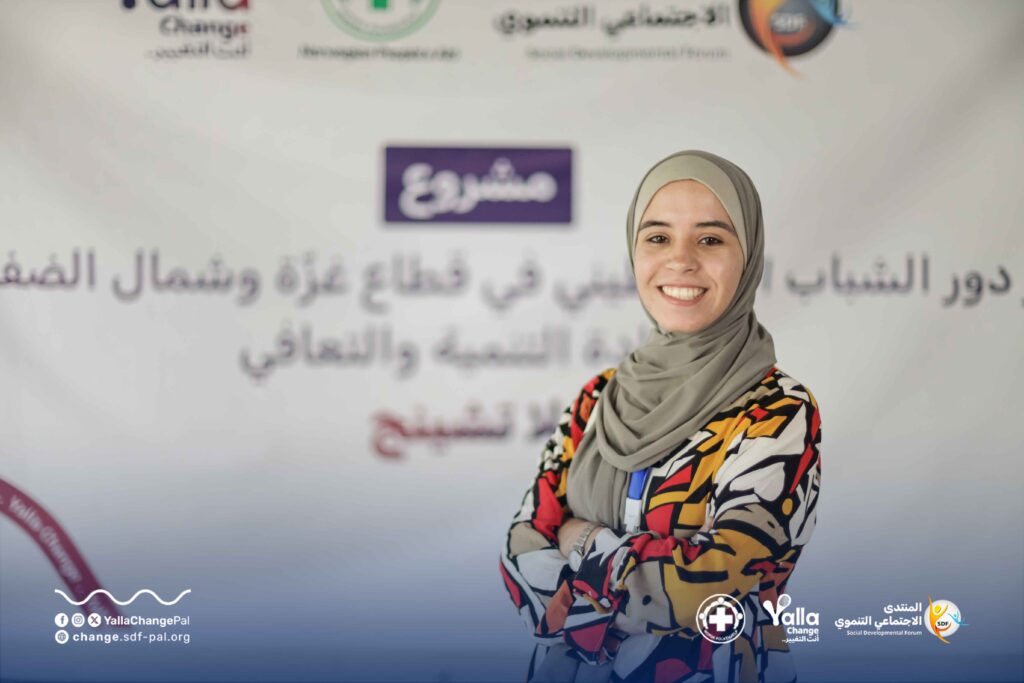
In a displacement camp in the Middle Area of the Gaza Strip, among rows of tightly packed tents, stands Nour Al-Bittar. The 23-year-old had just graduated with a degree in Multimedia & Web Development from the Islamic University days before her second displacement, as if the world handed her a diploma, then took away everything she knew about life in a single moment.
Despite her technical background, Nour has always been a field-oriented person. She describes herself as “a deeply social person”, never at rest unless she’s among people, connecting with them, sharing experiences, and listening to their stories.
The Human Existence: Her Primary World
Since 2017, she has been deeply involved in community work, defying everyone who said her field of study would isolate her behind a screen. She knew, deep down, that people were her primary world and that community was the space where she truly came alive.
When her graduation project began, she spent long hours immersed in her laptop, designing, coding, and building 3D models. But something was missing. Laughing about that time, she says, “I felt like software didn’t understand my feelings… or my ambitions.”
She started feeling a growing distance from herself, as the vibrant, proactive, and people-oriented person she knew began to fade. Then one day, while scrolling through Instagram, she saw an ad for the sixth season of the “Yalla Change” youth program in the Gaza Strip and the West Bank.
She didn’t know much about the program, but as she explored its page, she found it pulsing with community spirit. Something inside her was reawakened. “I thought, maybe here I can find my community-driven self again, the ‘Nour’ who loves fieldwork and connecting with people.”
She applied immediately, despite the poor internet connection that forced her to go to a co-working space to complete the application. However, recording the introductory video was a daunting task she dreaded. “I re-recorded that video 15 times,” she recalls with a laugh. “In the final take, I finally felt connected and spoke from the heart.”
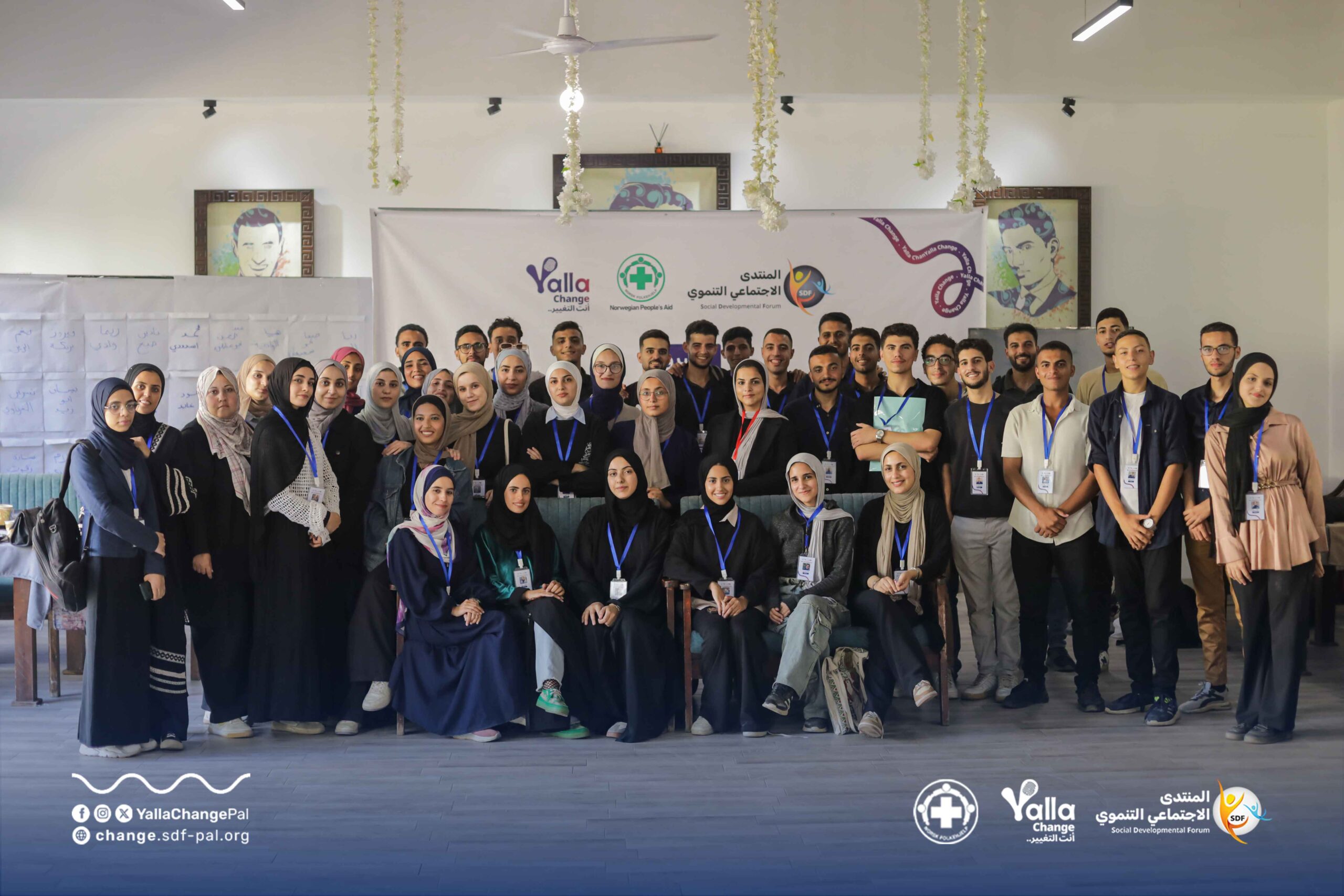
After a time of waiting, she was accepted to the interview stage. Given her circumstances, she chose to do it online. In the interview, she spoke with a quiet confidence about her experiences and ideas. A week later, the awaited message arrived: “Congratulations! You have been accepted from among more than 800 applicants… as one of only 60 participants in the programme.”
That message was a glee of hope. For Nour, it felt like a part of her had finally revived after months of stagnation, pressure, and fear.
A Space of Meaning Amidst the Tents
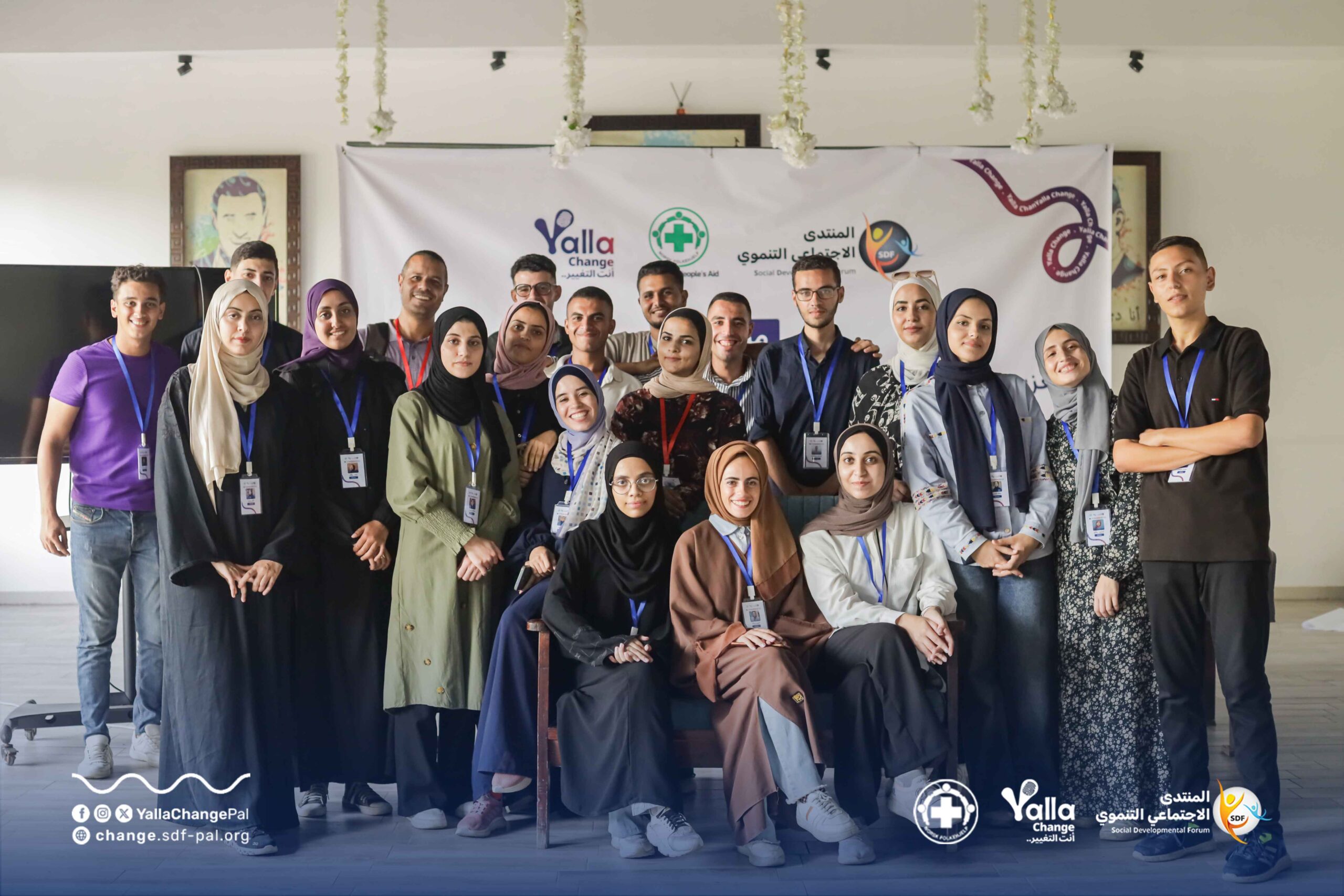
Nour joined Yalla Change and began the extensive training program run by the Social Development Forum in partnership with the Norwegian People’s Aid (NPA). The program aims to empower Palestinian youth to lead recovery and development efforts.
While it was a training program, for Nour, it was a lifeline. She would tell her family each day upon returning, “I come back with enough energy for a whole day… it’s like being taken out of the reality of Gaza for two hours.” In that space, she found 60 young people with different stories and passions, and with them, she felt that the world was still full of possibility.
What truly resonated with her was the concept of “Human-Centered Design,” introduced by trainer Hadeel Abu Zeid. She entered the session unfamiliar with the term and left seeing people in a new light. “It gave me a whole new perspective,” she says. “I began to truly see a person and understand their problem just from their posture or the expression on their face.”
She learned to analyze needs, to listen, and to understand a problem directly from the people experiencing it before seeking a solution. Then came the advocacy and social pressure component, a previously unknown world where she realized an initiative isn’t just an idea, it’s a voice, a tool for impact, and real change.
Finally, effective communication became her gateway to discovering her own capabilities. “I encountered 60 unique personalities, 60 distinct skills, and 60 powerful stories,” she reflects. “That, in itself, is a whole other dimension of learning.”
An Eye for the Human Being, First and Foremost
From the start of the training, Nour began to walk through the world differently. She no longer saw people as passing figures, but as individuals each carrying a story waiting to be heard. She constantly asked herself: “If we helped this person, what could change in their day? Their life? The entire camp?”
She saw a man complaining to his neighbor that the water wasn’t enough for his family, and she began to think, “What if we solved the water problem? Wouldn’t that create a better community? Wouldn’t that restore life to people?” In this way, the program was reshaping her awareness, honing her ability to see the person within, beyond just the external signs of exhaustion.
Nour speaks of the Yalla Change team with palpable gratitude, noting they created a beacon of light for youth during the darkest circumstances of displacement. She says of the program: “Yalla Change was a rebirth for me… a rebirth in the midst of annihilation.”
As for her message to young people, Nour sums it up in one powerful sentence: “Find your right place… because if a person isn’t in their right place, they crumble.”
She urges them to use the internet for learning and growth, and to follow platforms that offer opportunities, just as she did when she found Yalla Change and, in turn, found herself.
“I am from the people and dedicated to the people… because I am living the same reality and the same pain,” Nour says. She knows all too well the meaning of living through displacement, famine, and fear, which is why she feels capable of touching the pain of others and transforming her own suffering into the energy to help them.
She believes her duty is to extend a hand to those who are more vulnerable. And she believes that on her face, amidst the fatigue and dust, a light remains, a light that mirrors her name, ‘Nour’ (light.)